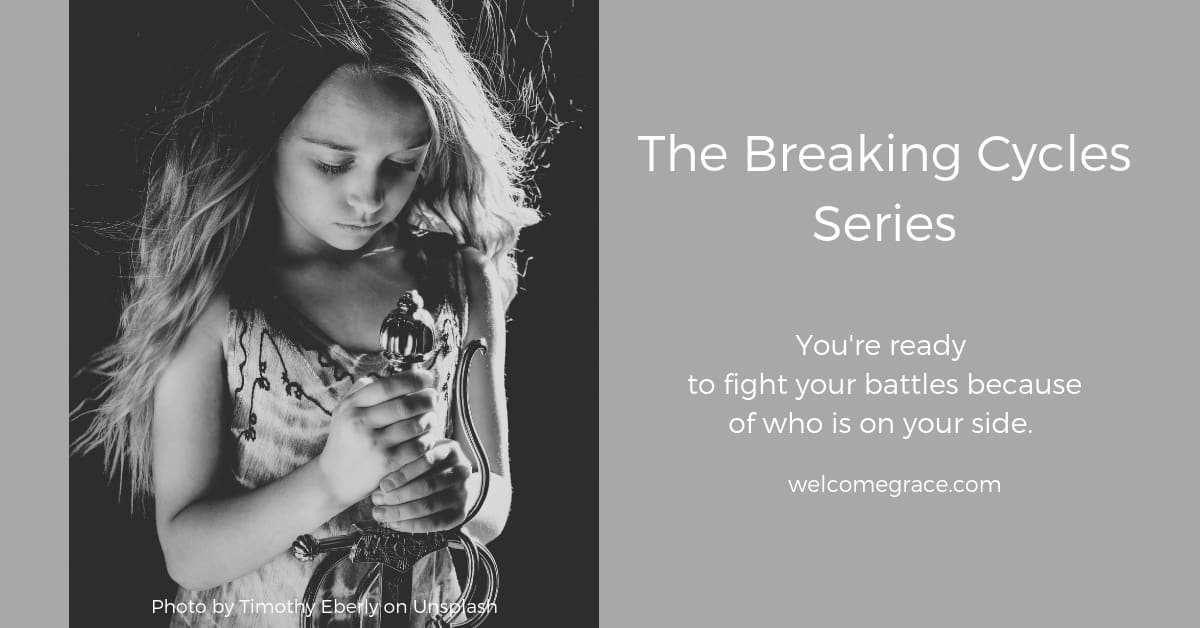
Breaking cycles is like fighting a battle. It’s a battle for your heart, mind, present, and, mostly, your future. You might be thinking, “Duh, I’m lying bruised and bleeding on the field and every time I get up, I get knocked down.”
Yes. It feels like that. It feels like loss and after loss. And it feels like you carry the losing banner everywhere you go.
Breaking cycles and patterns of thought sometimes feels like you lose more than you win because it’s a series of small skirmishes amidst decisive battles.
But we’re not alone. We might be surrounded by the enemies of our pasts or our own imaginations, but God says he prepares a table, a feast for us, in the midst of our enemies. He invites us to rest and in the respite we’re given the strength to stand and fight again.
The Psalmist describes God as a warrior riding the clouds in response to your cry. Psalm 18.
The breaking cycles weapons are not a pick yourself up by your bootstraps and keep a stiff upper lip and all that rot. It’s so much more.
Our weapons are the power of a heart fixed on the power of God. They’re spiritual weapons that enable you to tear down any thought, imagination, or mind-stronghold so that God’s truth can penetrate your heart.
The cycles and negative thought patterns begin before we’re even aware of what’s happening in our minds. It’s called a cycle because it’s become an automatic response. This is why one of the breaking cycle steps involve awareness of what’s in our minds. One way to interrupt the patterns of thoughts is by using your spiritual weapons to tear down thoughts and imaginings that don’t line up with God’s truth.
How do we do this?
We pray scripture.
We pray:
“In Jesus name, I tear down the pride that’s creating this stronghold.”
Or:
“According to Jesus’ power, I tear down the idea that someone is spreading rumors about me.”
Listen, we walk and live in the flesh. We live in this world. We still have the effects of our past in our present. Yet, we’re also not of this world. This world is not our home, but this is where we live.
What would happen if we were to apply the benefits of being a citizen of heaven to our life in this world?
Wouldn’t we reach for heavenly weapons rather than for our usual way of dealing with problems that plague our minds?
Couldn’t we share the power of God with others by applying the power of God to our own minds and praying for other’s who are locked into patterns of thought that keep them trapped in strongholds?
“For though we walk in the flesh (driven by our natural responses), we are not waging war according to the flesh (self-preservation). For the weapons of our warfare are not of the flesh (revenge, back-biting, vindication), but have divine power to destroy strongholds. We destroy arguments and every lofty opinion raised against the knowledge of God, and take every thought captive to obey Christ.” 2 Corinthians 10:3-5 (parentheses, my addition)
Jesus is our High Priest. He intercedes for us. And it’s because of him that God sees us as holy and righteous and it’s because of him that we can go directly to God and receive the grace that we need in the exact moment we need it. Hebrews 4:12-16.
There is a light that flows out like a river from God. He invites you to step into it, arms thrown back, and let that light overtake every single aspect of your mind and heart. It’s in that position where strongholds tumble.
It’s a battle of which you’re assured victory. You might feel as though you’re losing more than you’re winning, but you win when you’re faithful. I heard a best-selling author assert that your successes are built on your failures, but I proclaim that your successes are built on faithfulness.
It’s your faithfulness in trusting God and his faithfulness in directing every one of your steps while you’re breaking cycles.
The Takeaway
Prepare your heart for the battle by studying the Armor of God. I recommend Priscilla Shirer’s Armor of God study.
Think of a situation that sets your mind to setting up strongholds because of false imaginations and then pray 2 Corinthians 10:3-5. Out loud. And name what’s keeping you bound. Speak to it in Jesus’ name.
Take time to rest in God’s abundant love for you. That’s where you find your strength to stand and fight the battle.
It’s a commodity that seems to cost us more than it gives back. But rest is vital for our well-being. It shouldn’t induce guilt or shame, and yet, how many of us struggle with it?
There are times when I need a nap in the middle of the day, and if I’m honest, sometimes by 9am. I struggle to pause my activity so I can close my eyes for ten minutes. But when I don’t, I turn into scary Jessica. That’s the version of me that shows her teeth and and growls at anyone who comes near, including innocent laundry baskets and errant socks.
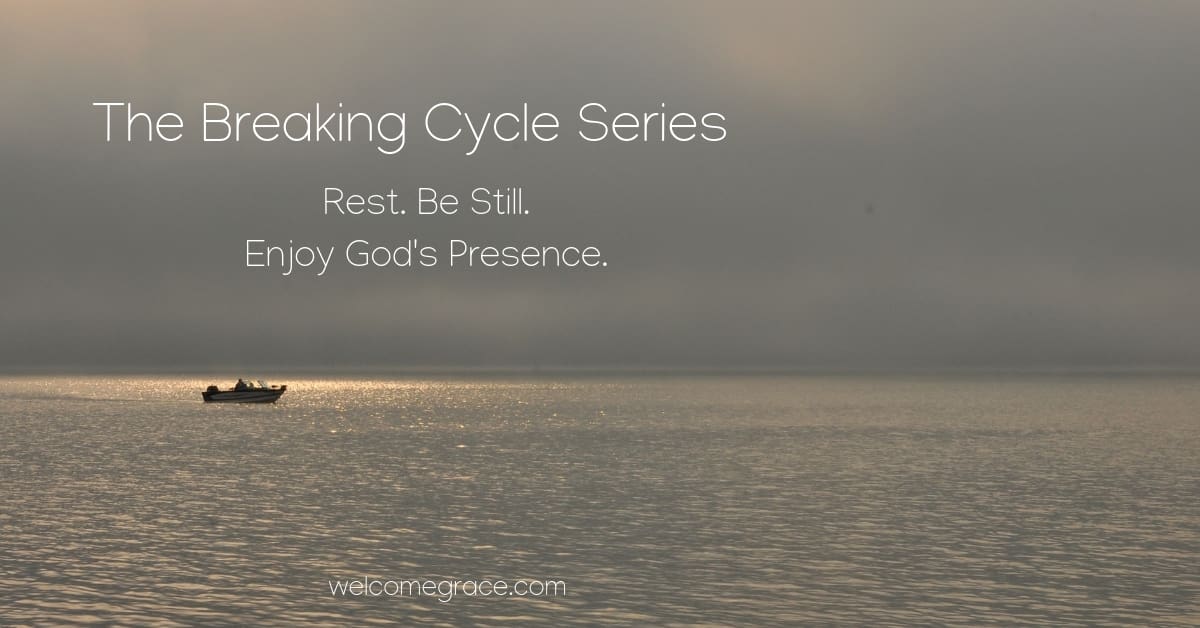
We need physical rest, but we also need spiritual and emotional rest as well. We need stillness.
Our bodies are still, and our minds are at rest. We’re given a break from the constant bombardment from noise, and our senses are soothed by the sight of lapping waters, the scent of earth and leaves, and the cooing of mourning doves.
God’s word is filled with visions of stillness. He leads you besides still waters so that your soul finds restoration. And he calls us to be still and wait for him to lead. Would that we could be as restful in the midst of our life’s storms as Jesus was when he napped in the boat during the violent storm on the Galilee Sea.
Still.
Breathe deep.
Embrace the quiet.
Stilling our soul is vital to breaking cycles.
For one, it enables us to learn to rely on the power of the Holy Spirit to work in us and through us. God knows our tendency to strive in our own strength, and so he gives us the gift of stillness so that we learn to wait for him.
Secondly, stillness gives us the opportunity to practice the presence of God. God’s presence doesn’t ebb and flow, but our awareness of it does. Stilling our soul gives us the opportunity to develop that awareness.
But what does this stillness look like?
It can be meditating on a passage of scripture that gives you hope or comfort or turning on worship music that sings of God’s attributes and character. And then turn those words into your own worship. Laying prostrate on the floor is an act of humility that reminds our soul that God is God and we are not.
You could take a leisurely stroll and study the leaves on the maple tree, the flowers that bloom or the way the goldfinch flits and flutters to its nest. Maybe you could lay on the grass, gaze at the clouds, and envision God riding to your rescue.
God loves you and longs for relationship with you that is filled with mutual enjoyment.
Yes, God teaches us in the ways of right living and he gently and tenderly convicts us when we travel off course. But he also enjoys us. He enjoys our quirks and interests because he gives them to us.
Enjoy him. Enjoy his kindness, sweetness, mercy, and grace. He is a good, good God and his heart is so good towards you.
He transforms you one step in one cycle at the time, but not every encounter with God will be a teaching encounter. There will be times when he removes the blinders off your eyes, and you will see clearly and change will overtake you.
Then, God graciously let’s those revelations take root in your heart, which means that you won’t be showed something new to work on every time you open your Bible. It’s in those moments when you read the Bible, worship him, and still your heart before him that you learn to enjoy him.
“Be still, and know that I am God. I will be exalted among the nations, I will be exalted in the earth.” Psalm 46:10
Breaking cycles requires a strong heart. Sometimes it seems impossible and we wonder if the effort is worth it. That’s why this step of rest cannot be skipped or glossed over.
Taking time to rest in God’s presence is what encourages our heart and gives us strength to keep walking the righteous-living, cycle-breaking road.
The Takeaway
Take time to quiet your soul and rest in God’s presence.
We use different filters in photography and post-processing to neutralize a bright scene or enhance blue skies, or draw the eye to a focal point. I have created presets for bringing out the eyes, whitening teeth, and getting rid of pesky under-eye shadows. Presets or filters applied the right way enhance the photo.
While it’s fun to play around with filters in Lightroom or Photoshop, filters used to hide the truth compete with the authenticity and transparency God desires in relationship with him.
Hebrews 4:12-16 tells us that everything is exposed before God, even the things we don’t want him to see or acknowledge to ourselves that they exist in our heart.
The Psalms are filled with raw, unfiltered emotion before God and that’s okay. We must have a way to express the raw, unfiltered emotions that navigating this life stir in our heart.
But, when we’re in the renewal and transforming process, a filter is an absolute necessary in training our hearts and thoughts into new patterns.
When we use God’s word as a filter for our lives, we don’t filter God’s word through our opinion, but our opinion and point of view through God’s word. And if there’s anything within us contrary to God’s word, then we readjust our point of view to God’s, we don’t readjust God’s point of view to fit ours.
We find the steps woven throughout the Bible and while this series includes practical steps to take, there also needs to be a foundational understanding of God’s love for you and your identity in him.
Philippians 4:8 is one of the filters we can use to filter our thoughts so that we generate new thoughts for our regenerated heart.
“Finally, brothers, whatever is true, whatever is honorable, whatever is just, whatever is pure, whatever is lovely, whatever is commendable, if there is any excellence, if there is anything worthy of praise, think about these things.” Philippians 4:8
I run my thoughts through this filter like I would run my raspberries through a sieve in order to separate the sauce from the seeds. I ask myself if what I’m thinking is true, honorable, just, pure, lovely, commendable, excellence, or praiseworthy. Using Philippians 4:8 keeps God’s word at the forefront of my mind and keep my mind pointed to Jesus’ ways.
True
When we consider true in the biblical sense we refer to true conduct, sincerity, uprightness, and honesty. We can be totally and completely true and honest with God about our hurts, anger, and frustration.
Honorable
Philippians 2:3-4 speaks of looking to others interests and not doing anything out of vain conceit, but in humility count others more significant than yourself.Honorable thoughts are thoughts are are filled with consideration, deference, and fair.
Just
There’s a growing demand for justice in our world, but let’s strip it back to the Greek definition of just which is morally righteous, impartial, and upright. Are your thoughts moral? Impartial? Upright? Or are you finding your thoughts filled with revenge or showing favoritism? Jesus declared that even if we think hateful thoughts we commit murder.
Pure
Pure thoughts are innocent and blameless. Blameless. I can’t tell you how many times my thoughts are filled with blaming others for my problems. If you want to break free of the victim mentality that keeps you hostage, start by developing thoughts that don’t point the blame.
Lovely
Lovely thoughts are thoughts that are friendly toward something or someone. Lovely thoughts are pretty difficult when we’re harboring unforgiveness and resentment towards someone or something. By filtering our thoughts through loveliness, we are made aware of any lingering vestiges of bitterness.
Commendable
Do you speak well of your enemies or situations or are you full of grumbling and revenge? Commendable means to speak well of. The key to being able to thinking on things that are commendable is replacing a grumbly heart with a grateful heart by focusing on God’s character and presence during and despite the difficulties we face.
Excellent
The Greek word for excellent refers to goodness of actions and virtuous deeds. Our actions are born out of our thoughts. What you think is how you act. If your thoughts are vengeful, you might just find those words you don’t mean to say, but mean in your heart, to fly out of your mouth like a dagger to wound and maim.
Worthy of Praise
Praiseworthy. Are your thoughts worthy of praise? Eventually, as you filter your thoughts through the other commands in this verse, they will be worthy of praise. Anything that is true, honorable, just, pure, lovely, commendable and excellent are praiseworthy. But the previous descriptions give color and nuance to this passage.
The Takeaway
Paul is calling us to action in Philippians 4:8. We don’t have to remain stuck in unhealthy patterns of thought, but can be set free as we progressively apply these principles to our minds.
Freedom comes by way of walking in the freedom that God made available with Jesus’ death and resurrection. So we practice. Every day. Every minute. Every second.
Then we rely on the power of the Holy Spirit to do his renewing work in our minds.