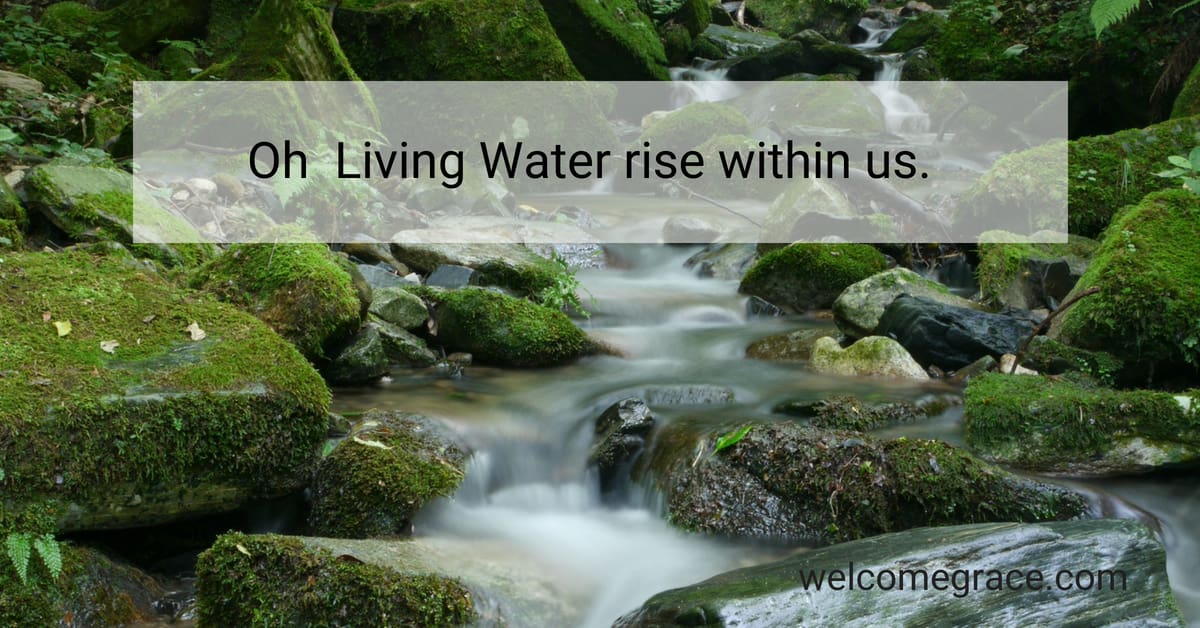
Imagine a wee little spring bubbling and gurgling, laughing and splashing life giving water on it’s surroundings. We see beauty in the rock’s hidden treasures that only wetness can bring. Our eyes caress the little mountain wildflowers and we wonder at that perfect shade of lavender. The little spring accomplishes so much as it feeds life into it’s environment.
“But whoever drinks of the water that I give him will never be more thirsty again. The water I give him will become in him a spring of water welling up to eternal life.” John 4:14
The Holy Spirit lives within those who receive Jesus as Savior and Lord. Transformed and made whole hearts happen because of the up-springing of the Holy Spirit within us. The Holy Spirit is the spring within us that gives us victory over our old life, makes real the things of Christ, and helps us realize the Fatherhood of God.
When the Holy Spirit can flow through our lives unquenched and ungrieved, he takes up our troubles and fears and settles them for us according to God’s will. The Holy Spirit makes a way for our outer lives to be the unforced reflection of an inner life which is pure, full of tenderness, looks on humanity with a heart of love, and watches for opportunities to offer a helping hand to lift up the oppressed and weary.
The power of God lives within us like the little spring in the woods. Sometimes we wonder if it will ever run dry, but then we hear the whisper of the upper spring assuring us that we’re connected to a much bigger source that will never run dry. It’s only risks are blockages to the flow. Muddy leaves or falling branches will prevent the grand-daddy springs from feeding the little spring.
What blocks the flow of the Holy Spirit in our lives?
Grieving the Spirit
“And do not grieve the Holy Spirit of God, by whom you were sealed for the day of redemption. Let all bitterness and wrath and anger and clamor and slander be put away from you, along with all malice.” Ephesians 4:30-31
Bitterness, wrath, anger, clamor, slander, and malice grieve the Holy Spirit. Every time we justify one of these by saying, “God made me with a quick temper, it’s just the way I am, he’ll understand.” It might be the way you are, but have you considered the consequences to the person you took your quick anger out on? We don’t live as isolated islands, but intertwined and inter-dependent on one another.
All the things we keep in our hearts, defended, hidden, petted, and justified choke the inlet and outlet of the Holy Spirit in our life.
Quenching the Spirit
“Do not quench the spirit.” 1 Thessalonians 5:19
Is it easy or hard for you to say yes to God? When God says to pray, do you? When he says be still, do you get busy? When he says give your time or money, do you find ways to get out of it?
Each time we say “no” to the command to pray, give, or serve, we block the flow of the Holy Spirit in our lives.
Say yes with your whole heart.
The Takeaway
My beautiful friends, it’s not about getting more of God in you by praying harder or doing more, it’s about taking into account the fact that you have him already. As C. I. Scofield states, “If you really believe that the Holy Spirit of God dwells in your mortal body, a transformation of life has begun.”
We don’t base this God-life on feelings but by receiving the facts by faith. God lives within you, you are seated in the heavenly realms with Christ, and the Holy Spirit lives within you. Those are facts that you can receive by faith.
Is it our name that makes us who we are or who we are that marks us with our identity?
How many feuds have been won and lost simply over a name: The McCoys and Hatfields, The War of the Roses, or The MacDonalds and the Campbells. If you were born a Campbell you were feuding with the MacDonalds whether you were aware of it or not. You were entwined into the family feud based on your birth, not by your choice.
Our identity is found in many things: Our family name. Our family history or our lack of family history. Our accomplishments. Our failures. Our fears. Our successes. Our strengths. Our weaknesses.
And it is those very things that can stand in the way of identifying ourselves in Christ. He is where we find our identity, but so often life confuses us and blinds us and we come to Christ recognizing him as our Savior, but struggling to recognize him as Lord. Is this where we fall short in surrendering our identity for his? We recognize him as our Savior, but don’t know how to make him our Lord? The battle for lordship begins and ends with identity.
Who do you say you are?
I say I am a wife, ‘just’ a mom to some, but ‘mom!’ to the four people that matter. I homeschool and in some circles that is celebrated and in some circles it is ridiculed. I am flawed. I find it difficult to forgive myself. I label myself: failure. reject. My mistakes replay in my mind like a broken record.
Who does Christ say you are?
Christ says I am chosen. I am blameless. I am enough. I am approved. I am free. I am righteous. I am an heir. I am a royal priest. I am a minister. I am loved. I am forgiven. I am His.
Did I become each of these things the moment I accepted Christ as my Savior? Yes. However, did I believe them immediately? No. Honestly, accepting my new identity in Christ has taken me many years to embrace, and it has become part of my transformation.
Gideon (Judges 6-7) hid in a winepress while threshing grain because he was hiding from his enemies when an angel appeared to him and called him a ‘mighty man of valor’.This angel proceeded to launch Gideon on a path of bravery and courage. But, Gideon had to be thinking, ‘Are you kidding? I am hiding! I’m too scared to thresh this grain in broad daylight and you call me what?’
Could Gideon have called himself a coward? Did he take that on as his identity? I believe he might have. But God called him by another name. God wanted him to grow into his new identity.
Craig Groeschel writes in his book ‘Altar Ego‘: ‘Gideon, empowered by God, grew into the true meaning of his name. God will do the same of you, but you must be willing to let go of the old name to grow into the fullness of your true identity.’
There are two things that I see in this quote and in the story of Gideon:
Gideon was empowered by the Holy Spirit
Gideon had to be willing to let go of his old identity
We can do nothing outside of the power of the Holy Spirit. Absolutely nothing. We can tell ourselves we are chosen and hope that we will begin to believe it if we repeat it to ourselves long enough, but for that belief to become really real to us we must turn to the Holy Spirit to empower that belief in us. Rather than repeat ‘I am chosen’ we say ‘Holy Spirit, empower me to believe that I am chosen.’
The second thing we have to do is to put aside our old identity. So that means we put aside the label of rejected. or failure. or loser. or successful. We have to be willing to let it go and be willing to grow into the fullness of our true identity in Christ through whatever means he chooses to use.
This is where our identity in Christ and his lordship in our life come to a cross roads because sometimes the ‘whatever means he chooses to use’ leads us down a road that we would not willingly choose to go on if we knew exactly what was around the bend. Sometimes that identity of who we are in Christ comes to us like a sunrise and sometimes it comes to us through a disaster, but the means is not the end goal. The end goal is for each of us to become who Christ says we are: